


Call me old fashioned, but it continues to surprise me that so much of the corruption that pervades the Trump presidency is out in the open for all who care to see it. This week, a new web of conflicts of interest was revealed, in an official report the President filed with the Office of Government Ethics. It’s a catalog of thousands of individual stock trades made by the President earlier this year. Skim it and you’ll find it hard to avoid the conclusion that, to Donald Trump, governing is synonymous with profiteering.
To save you some effort, I’m breaking down the highlights here, along with some legal background and suggested action items and reforms.
Trump’s Stock Trading Disclosure
The report in question is called a Form 278-T, also known as a Periodic Transaction Report. Executive Branch officials, including the President, are legally required to complete Form 278-T every time they buy or sell a stock or bond worth more than $1,000. The form is submitted to the Office of Government Ethics, which reviews and publishes these disclosures in a searchable database.
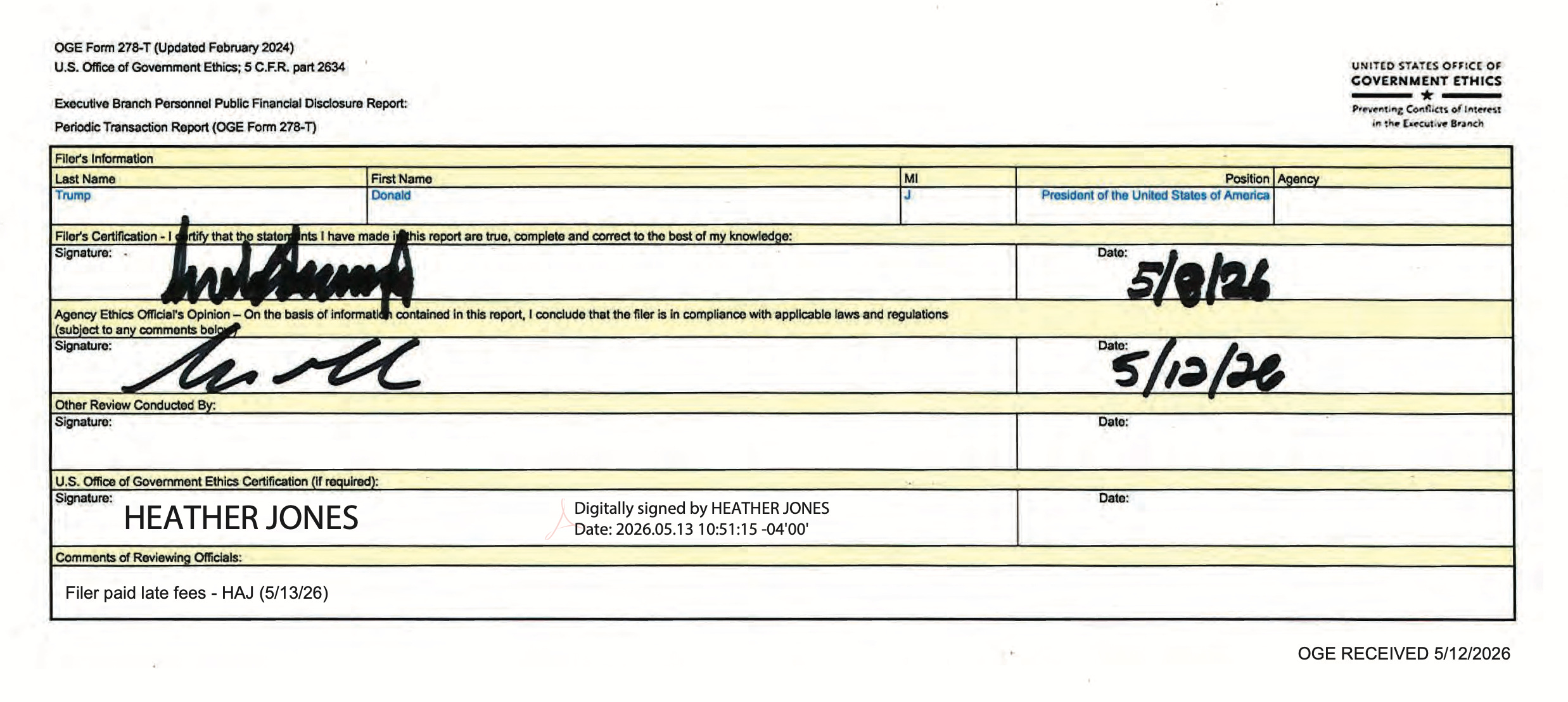
On May 8, Trump signed a Form 278-T covering the first quarter of 2026. His filing was months late—the law requires reporting within 30 to 45 days of a transaction—and Trump was fined accordingly, but to some observers, the fact he filed at all was a surprise.
Trump’s disclosure spans 113 pages. It lists more than 3,600 stock trades between January and March of this year. The filing reveals that Trump bought and sold hundreds of millions of dollars in stocks, including big tech, defense contractors, media companies, crypto, and more. The form uses ranges, not exact amounts, so the precise value of Trump’s trades is not known, but the total is between $220 and $750 million.
This report provides only a partial picture of Trump’s trading activity, because it includes only his personal holdings. His corporate assets, including his many business interests under the Trump Organization umbrella, are not subject to disclosure.
Notable Transactions
What’s notable about this is not just that Trump is staggeringly wealthy. It’s that he is heavily invested in companies whose businesses are directly affected by policies he is making. He is actively trading in their stocks at the same time he is making decisions that influence the value of those stocks.
The form is filled with notable examples, of which I will highlight just a few.
Trump invested in both Paramount and Warner Brothers while his Justice Department is reviewing their highly controversial proposed merger.
He invested in Oracle at the same time he brokered their deal to buy TikTok, setting aside concerns about national security.
He invested in Palantir as they competed for and won major government contracts, worth billions of dollars, in defense and other sectors.
He bought numerous crypto stocks while pushing a bill called the Clarity Act, which would benefit the crypto industry (which is actively lobbying for its passage).
One of Trump’s biggest buys was millions of dollars in Nvidia stock. Nvidia makes advanced AI chips, which they have been trying to sell to China for years. The U.S. government has restricted the sale of these chips to protect our national security. But Nvidia’s CEO lobbied Trump for months to change that policy, and in December, Trump agreed—raising alarm among foreign policy and security experts.
Then Trump went a step further. This week, he took Nvidia’s CEO to China with him—on Air Force One—to sell their AI chips to the Chinese government. During the trip, the U.S. government for the first time cleared 10 Chinese companies to purchase the chips. Nvidia’s stock price has now climbed 26% since January, and 70% over the last 12 months.
This week, Trump also took the CEO of Boeing to China with him—after buying millions of dollars of Boeing stock. On the trip, they reportedly sold 200 Boeing airplanes to the Chinese government, with the potential to sell hundreds more.
An analysis by Fortune observes that Trump’s stock account has repeatedly “traded around” domestic and international events, as well as the President’s official actions and public statements. For example, in January, during a severe egg shortage, Trump “bought Cal-Maine Foods, the country’s largest egg producer”; he sold this stock in a substantially larger amount two months later. In February, Trump bought millions in Dell stock. He then urged the public to “go out and buy a Dell”—after which Dell’s stock price surged 24%.
When he began the Iran war, Trump sold large positions in American companies and “traded into safe-haven stocks like gold and treasuries, even as he said the war would end soon.” He later bought up energy, defense, and aerospace stocks: “the companies that stood to profit if the war dragged on.”
Ethics and Conflict of Interest Considerations
It’s impossible to look at Trump’s trading and not ask: Is Trump actually acting in the interests of the American people? Or is he placing his own financial interests first? At this point, it may be a chicken-or-egg question. Trump’s personal portfolio is so thoroughly intertwined with his presidential portfolio that it is impossible to judge whether his investments are influencing his policies, or his policies are influencing his investments, or both because they are one and the same.
An analysis by the Cato Institute observed:
The Trump administration has spent the past year treating policymaking like a series of business transactions. So, when the president can decide which firms receive export permission, tariff relief, merger approval, or even a direct government ownership stake, his personal investments become a public concern.
Richard Painter, a leading presidential ethics expert and White House ethics counsel under George W. Bush, analyzed Trump’s trades during the Iran war. As reported by Fortune:
Painter said this is exactly the kind of trading a president shouldn’t do, because the president has both confidential information about overseas developments and the power to move commodities markets through his own decisions. Even with no one in the family directing the trades, he said, it misses the point. “He has no control over the accounts? That’s beside the point. He certainly has the control over the decision about whether we went to war or not.”
Contrast with Other Presidents
Other presidents have chosen to sell off their stocks or place them in a blind trust before assuming office to avoid any potential conflicts of interest. Painter, the ethics expert, told Fortune: “I’ve gone through every President. I don’t think we’ve had any President trade in the stock market.”
Unlike other Presidents, Trump has persistently refused to divest his stocks or employ a blind trust. As Fortune reported:
Since Lyndon Johnson pioneered the use of a presidential blind trust in 1963, every modern president has either placed their assets in a blind trust managed by independent trustees, held them in index funds and Treasuries, or, in Jimmy Carter’s case, liquidated all their assets (notoriously, his peanut farm). None have actively traded individual securities while in office. Until recently.
Trump’s son Eric has claimed that his father’s holdings are in a blind trust and that he does not trade individual stocks. This is clearly false. Trump’s Form 278-T lists hundreds of individual stock trades. Moreover, the form is personally signed by Trump; a defining feature of a blind trust is that the owner does not know what assets it holds.
Personal Profit and Corruption
The New York Times estimated that Trump pocketed at least $1.4 billion during the first year of his second term. The Wall Street Journal reported that the Trump family has generated at least $4 billion in profits from new business ventures since Trump was reelected. The Trump family is profiting from a staggering array of new business ventures, including drone manufacturing, a golf club in Qatar, a resort in Saudi Arabia, and crypto deals with foreign billionaires—as well as sales of bibles, sneakers, and guitars. The Associated Press recently reported that Trump’s net worth is now $6.3 billion, as estimated by Forbes—an increase of 60% since he returned to office.
When asked about potential conflicts of interest, Trump responded: “I found out that nobody cared, and I’m allowed to.”
The definition of corruption is using official power for private gain. By that measure, Trump is hands down the most corrupt President in history. His Form 278-T is a roadmap to the ways he is personally profiting from the powers of the presidency.
Legal Framework and Potential Reforms
After Watergate, Congress enacted the Ethics in Government Act of 1978 as a measure to enhance transparency and accountability for public officials and to restore public trust in government. The Act created the Office of Government Ethics, which oversees compliance with federal ethics laws and the financial reporting requirements imposed on public officials.
In 2012, Congress enacted the STOCK Act, which prohibits Members of Congress and their staff from trading stocks based on nonpublic information learned through their official positions. The Act also created new disclosure requirements for a range of federal employees—including the President and Vice President—such as the stock trade reporting requirement reflected on Form 278-T, among others.
However, these rules have limited effect as far as the President is concerned. Most Executive Branch officials are expressly prohibited from participating in official matters in which they have a financial conflict of interest. Failure to disclose and avoid conflicts can result in criminal penalties. But the President and the Vice President are specifically exempted from that rule.
Dating back to his first presidency, Trump has repeatedly claimed that “the President can’t have a conflict of interest.” As a factual matter, that is incorrect. But as a legal matter, there is no enforcement mechanism in place that restricts the President from acting under conflicts of interest.
Congress can and should revisit the existing rules, which rely on the President to do the right thing voluntarily—a quaint aspiration in the era of Trump. The Supreme Court’s presidential immunity ruling may eliminate the possibility of criminal penalties. But monetary penalties—such as fines and disgorgement of profits—may be better suited anyway to deter a person motivated principally by personal gain.
Congress should also act to further restrict stock trading by government officials. Both Democrat and Republican voters broadly support a total ban on stock trading by Members of Congress. Legislation to enact such a ban has been proposed many times, including a bipartisan bill introduced by Senators Ashley Moody (R-Fla.) and Kirsten Gillibrand (D-NY) in January. Their bill, however, would not apply to the President.
Last year, President Trump sharply attacked Republican Senator Josh Hawley after he advanced a bill that would ban stock trading by the President and Vice President as well as Members of Congress. Trump accused Hawley of “targeting” him, calling Hawley a “second-tier Senator.” Trump’s most recent Form 278-T leaves no doubt about why he was so angry about Hawley’s proposed bill.
Another issue is the limited ability of the Office of Government Ethics to enforce existing rules. The Office is not an investigative agency with subpoena power. Moreover, it lacks independence from the President. Within weeks of returning to office, Trump removed the Office’s Director, who had been confirmed by the Senate to serve a five-year term just two months earlier. Since then, the Office has been led by a “revolving door” of political loyalists who answer directly to the President. Like many other executive agencies, OGE needs reinforcement.
Action Items
I know many of you will want suggestions for actionable items. I have two.
First, share this information widely. Use your voice to raise public awareness and keep a spotlight on the abuse and corruption of official power.
I know this might not feel much. But it is actually one of the most important things we can do right now. There is no legal remedy for the kind of corruption we are now witnessing. Our laws were not designed with a president like Donald Trump in mind. The framers of our Constitution did not conceive of the possibility that we could elect a president who would loot and pillage our country without a shadow of shame.
So it falls to us, the citizens, to push back and demand change. We cannot afford to elect another leader like Trump. Educating our fellow citizens is how we ensure that we do not continue to empower officials who will put their personal interests ahead of the interests of the American people.
Second, call your elected representatives. Tell them this kind of corruption is unacceptable. Ask them to enact legislation that does the following things:
Bans stock trading by ALL government officials
Eliminates the President and Vice-President’s exemptions from federal conflict-of-interest laws
Imposes new financial penalties for violating conflict of interest laws
Bolsters the resources and independence of the Office of Government Ethics
There is no quick fix to the mess we are in. But that doesn’t mean we should give up. These are small steps, but they are a path to change.
He should not be able to get away with this. Why does he think he's so special that he doesn't have to follow the rules? How much more will he get away with?
Thanks Liz. I value the info you shared!👏💙