


One of the hardest questions Todd Blanche will have to answer at his upcoming Senate confirmation hearing is how Ghislaine Maxwell—a convicted sex offender and partner-in-crime to Jeffrey Epstein—ended up in a minimum-security prison. Maxwell’s transfer last summer to a Federal Prison Camp violates Justice Department regulations, which require convicted sex offenders like Maxwell to be housed in higher security facilities for the protection of the surrounding community. Maxwell is the only person in history known to have received an exemption from this policy.
This breach of longstanding policy is a problem for Blanche as he faces a tough path to confirmation as Attorney General—and he knows it. This week, he tried a new tactic to deceive the public about the special treatment Maxwell is receiving and to conceal his role in facilitating it. In an act of brazen dishonesty, the Federal Bureau of Prisons—which Blanche controls—issued an indignant new statement claiming that Maxwell’s transfer was for legitimate reasons, that she has received no preferential treatment, and that Blanche had nothing to do with her transfer.


All of this is demonstrably false and deliberately designed to mislead. And in fact, while preparing this post, I stumbled upon what sure looks like an official admission that Blanche broke the rules when he orchestrated Maxwell’s transfer to the camp. I’m going to explain exactly how. It’s a bit of deep dive, but I hope you’ll keep reading.
Prison rules and regulations are complex, technical, and arcane. Most of the public—and even most lawmakers—have had no reason to study them. And that’s exactly what Blanche is counting on. He’s trying to exploit our ignorance so we’ll fall for his lies.
Unfortunately for Blanche, there are some people who have studied these rules closely and who know how they work in practice for ordinary people. I am one of them. I learned how the Bureau of Prisons really works during my ten years representing clients as a Federal Public Defender and my three years working in coordination with the Bureau of Prisons as DOJ Pardon Attorney. I want to walk you through exactly what’s happening here and unpack all of the lies.
I hope that members of the Senate Judiciary Committee—who will have the chance to question Blanche under oath next month—will read this as well. We need our senators to look closely at what Blanche’s DOJ has said and done regarding Ghislaine Maxwell, and to check it against the facts and the law. We need them to hold Todd Blanche to account before he becomes our next Attorney General.
A quick refresher on the basic facts and timeline
Four years ago, in June 2022, Ghislaine Maxwell was sentenced to 20 years in federal prison after a jury convicted her of conspiring with Jeffrey Epstein to sexually exploit young girls. Maxwell was sent to a low-security prison in Tallahassee, Florida, to serve her sentence. Maxwell remained at that facility as of last summer.
On July 24, 2025, Todd Blanche—then the Deputy Attorney General—traveled to Tallahassee to visit with Maxwell. He met with her for approximately nine hours over the course of two days. A friend of Blanche’s—a Florida lawyer named David Markus—was brought in to serve as Maxwell’s legal counsel during this meeting.
Blanche allowed Maxwell to have a special meal of her choosing during the meeting. According to Markus, “she requested Camembert cheese and fresh French bread.” Markus brought her the best he could find, and reports that she enjoyed “the greatest meal she had ever eaten in her life.” Maxwell, in turn, gave assurances on the record that Trump was “a gentleman in all respects” and “absolutely never” did anything inappropriate with Jeffrey Epstein.
Days later, Maxwell was transferred out of the Tallahassee prison to a minimum-security camp in Texas, where she remains today according to public records. Maxwell has said she is “much happier” at this new facility, which she has described as having significantly better food, amenities, and living conditions.
What DOJ is saying about Maxwell’s transfer
Blanche initially claimed that Maxwell was transferred because of threats to her safety. In an interview in December, he said: “At the time that I met Miss Maxwell, there was a tremendous amount of scrutiny and publicity toward her, and the institution she was in, she was suffering numerous and numerous threats against her life.” But Blanche never substantiated or elaborated on those supposed threats.
Fast forward six months to June 16, 2026. Democratic congressional staff traveled to the camp in Texas where Maxwell is now housed to investigate claims that she is receiving special treatment. They confirmed that Maxwell is the only sex offender in the facility, which they described as essentially “a park with ample green space,” and they questioned why Blanche sent her there.
In response, the Bureau of Prisons issued the statement below (emphasis is mine) purporting to “correct the record” on Ghislaine Maxwell. In short, it claims that (1) the decision to transfer Maxwell was made “independently by BOP,” not by Todd Blanche; (2) Maxwell’s transfer was necessary and appropriate to ensure her safety; and (3) Maxwell received no special or preferential treatment. All of these claims are demonstrably false.
In light of the recent congressional staff visit to Federal Prison Camp Bryan, the Federal Bureau of Prisons (BOP) must correct the record as it relates to the intense public interest in inmate Ghislaine Maxwell. While the BOP takes extraordinary efforts to protect the rights and privacy afforded to inmates, recent mischaracterizations have made this statement necessary.
BOP designates and transfers inmates based on established criteria, including required security and supervision levels, separation needs, medical considerations, and, most importantly, inmate safety. Political rhetoric over the last six months has perpetuated a false and dangerous narrative that has metastasized into outright lies perniciously spread online and in some irresponsible news outlets.
Inmate Ghislaine Maxwell’s designation and transfer were made independently by BOP and were based on these factors that required additional security measures. Inmate safety is a key consideration, and we could no longer ensure her safety at her original facility. The current facility provided BOP the opportunity for improved security measures and a leadership team specifically equipped to handle the management of these needs.
No preference, special treatment, or political influence played any role in these decisions. Claims that inmate Maxwell has received preferential treatment, enhanced living conditions, unusual privileges, or that her placement was the result of outside interference are categorically false and inaccurate.
How the federal prison system actually works
Federal law gives the Bureau of Prisons (BOP) the exclusive authority to determine where a person convicted of a federal crime serves their prison sentence. BOP designates a specific facility from among more than 120 federal institutions nationwide. That decision generally is not reviewable by any court. But there are rigorous requirements that BOP must follow. Among other things, federal law prohibits preferential treatment: “In designating the place of imprisonment or making transfers under this subsection, there shall be no favoritism given to prisoners of high social or economic status.”
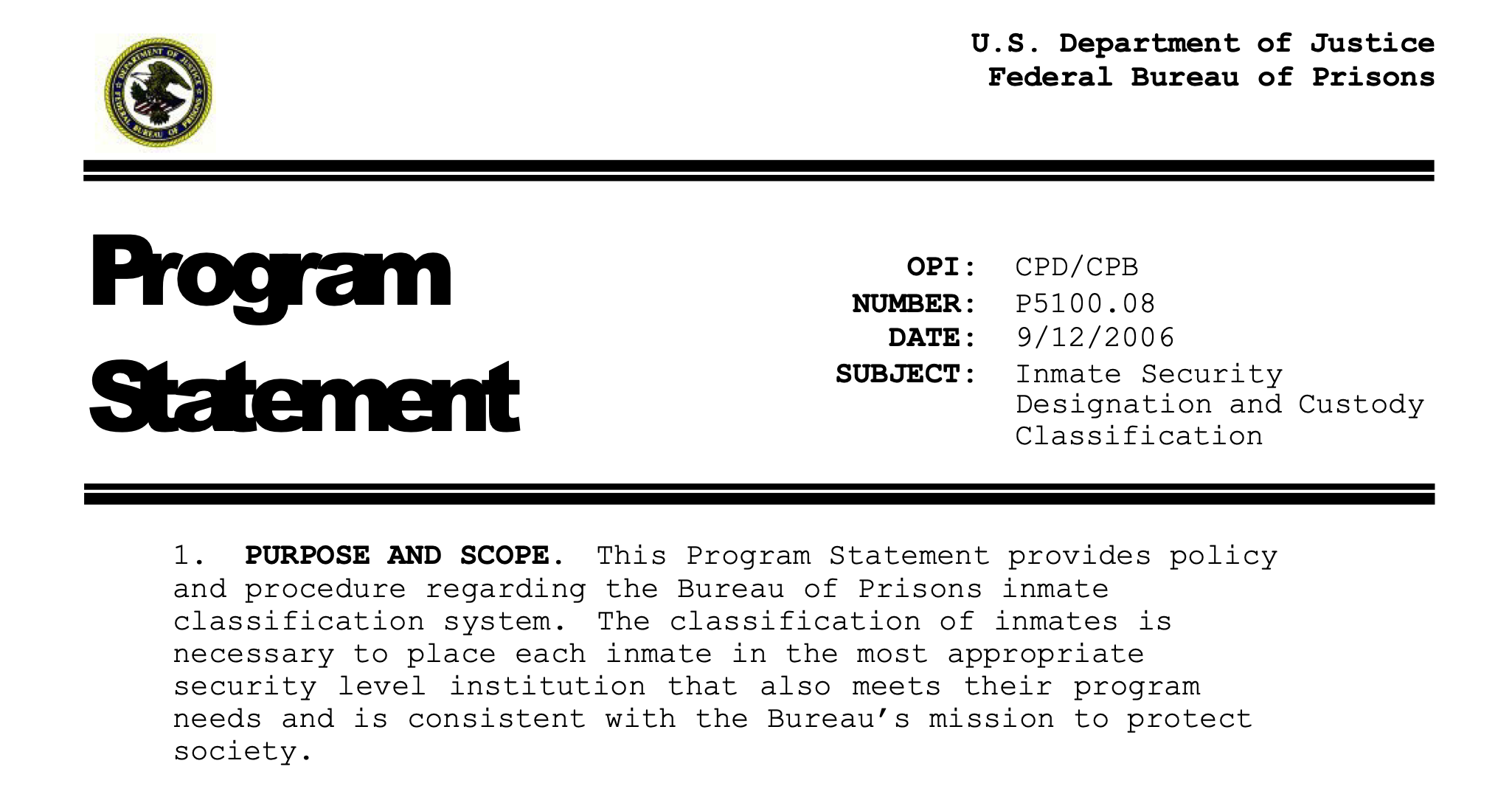
BOP has extremely detailed regulations that govern every aspect of the process known as “security designation and custody classification” of federal prisoners. They are memorialized in a 100+ page manual called Program Statement 5100.08. I’ll walk you through the key aspects for purposes of understanding the Maxwell case.
The security classification process
Every person incarcerated in the federal system is assigned a security level, based on their individual history and characteristics. For women, security levels include: minimum, low, and high (as well as “administrative,” in cases of special needs like medical care). Most women “are classified at minimum or low security levels.”
The security level is calculated in accordance with very detailed criteria, considering factors like the person’s criminal record, the seriousness of their offense, and a series of “public safety factors”—like gang affiliation, prior escape attempts, and a history of sex offenses (among others). Specialists in BOP’s Designation and Sentence Computation Center (DSSC) enter all of the relevant information into a system called Sentry, which calculates a point score and a corresponding security level.
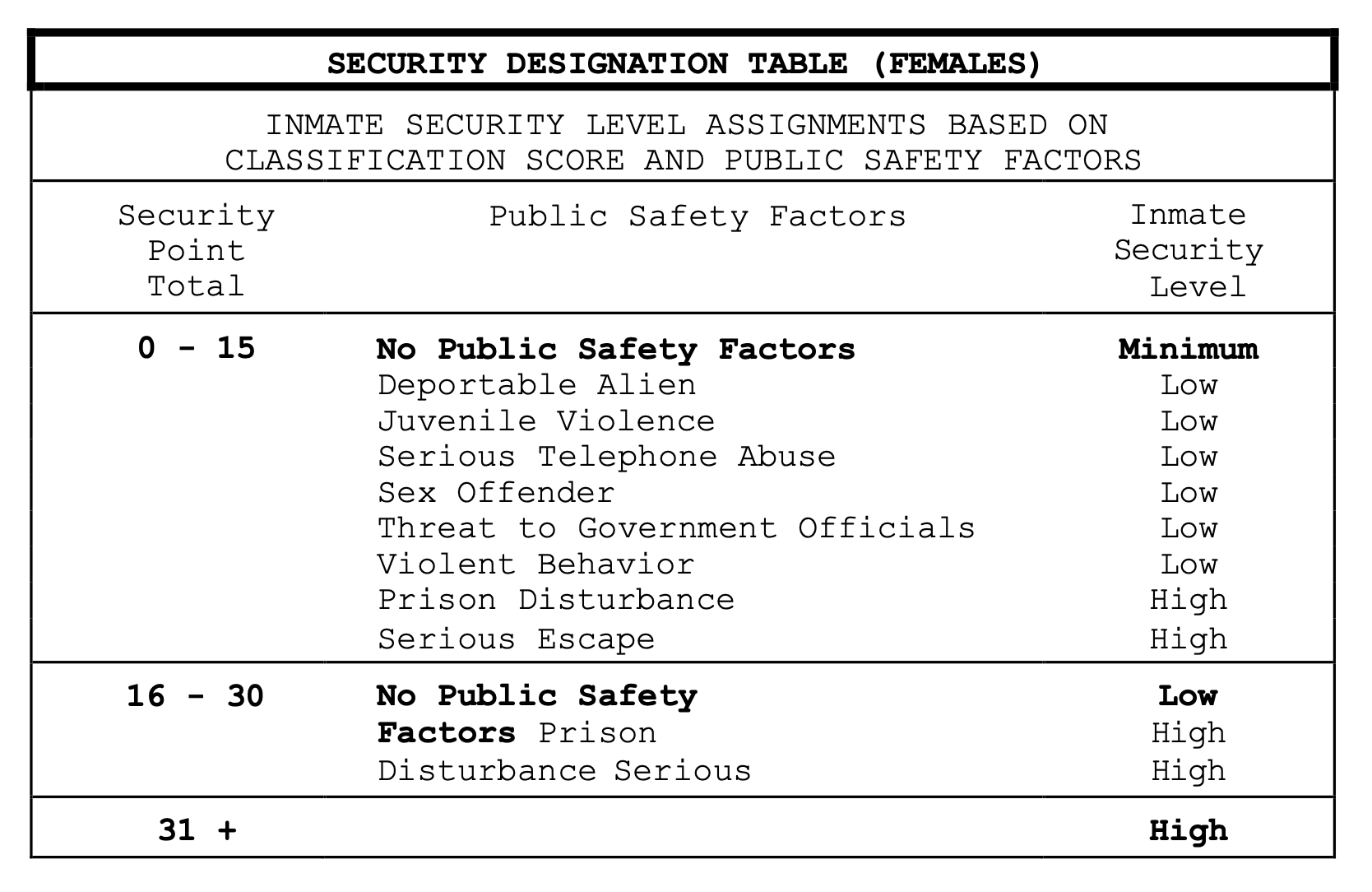
Incarcerated people (I try to avoid words like inmate) are required to be confined in institutions that match their security level. That means, if your security level is “low”—like Ghislaine Maxwell—you will be assigned to a low security prison.
Special restrictions for sex offenders
BOP’s regulations strictly prohibit housing individuals convicted of sex offenses—like Maxwell—in minimum security camps. The purpose of this restriction is to protect public safety. Prison camps are the least secure of all federal prisons. They generally offer direct access to the surrounding community, without the protection of a secure perimeter. BOP describes these facilities as follows:
Minimum security institutions, also known as Federal Prison Camps (FPCs), have dormitory housing, a relatively low staff-to-inmate ratio, and limited or no perimeter fencing. These institutions are work- and program-oriented.
Sex offenders cannot be housed in camps because sex offenses are considered a “public safety factor.” Public safety factors “are certain demonstrated behaviors which require increased security measures to ensure the protection of society.” In other words, they are factors that require confinement in a higher-security facility for the safety of the surrounding community.
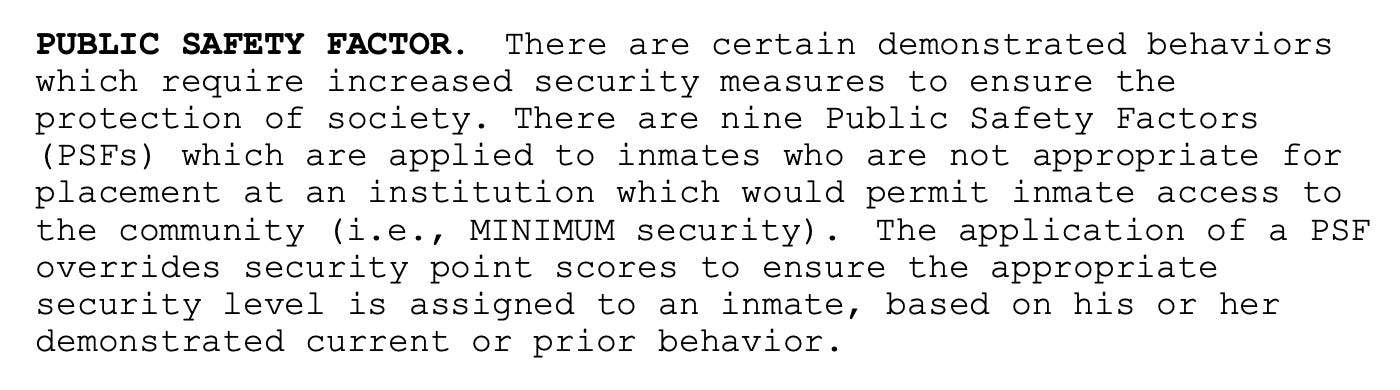
Because of the public safety risk, sex offenders are required to be housed in “at least” a low security facility, pursuant to BOP policy.
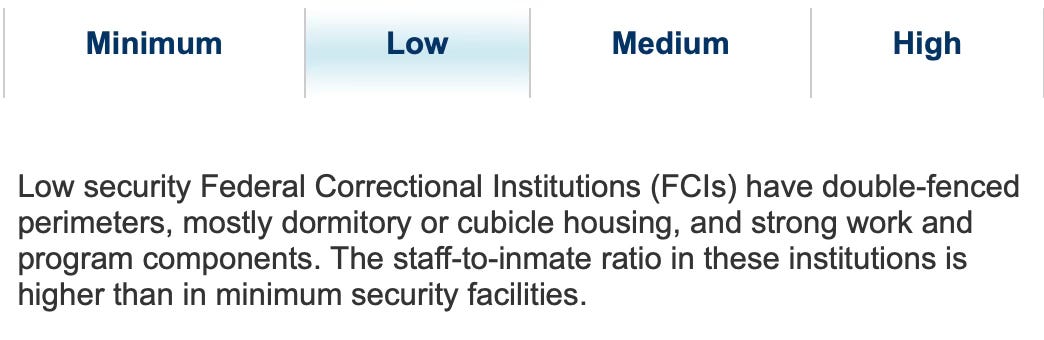
While “low security” might not sound all that restrictive, these facilities differ from minimum security camps in several important ways: low security prisons have “a double-fenced perimeter” (meaning residents cannot walk off into the community) and a higher staff-to-inmate ratio than camps. They may also offer more limited recreational programming and other privileges.
Waivers and changes in security level
Security classifications are generally reviewed on an annual basis. A person’s security level can change over time based on factors like their conduct in prison. Good behavior can lower the security level, while bad behavior can increase it. But public safety factors—like sex offenses—are generally fixed. That means, no matter how good their behavior in prison, a designated sex offender can never achieve a minimum-security level.
Under longstanding BOP rules, the only way a person with a public safety factor could be housed in a minimum-security facility is if the public safety factor (PSF) is “waived” and a “management variable” is applied.
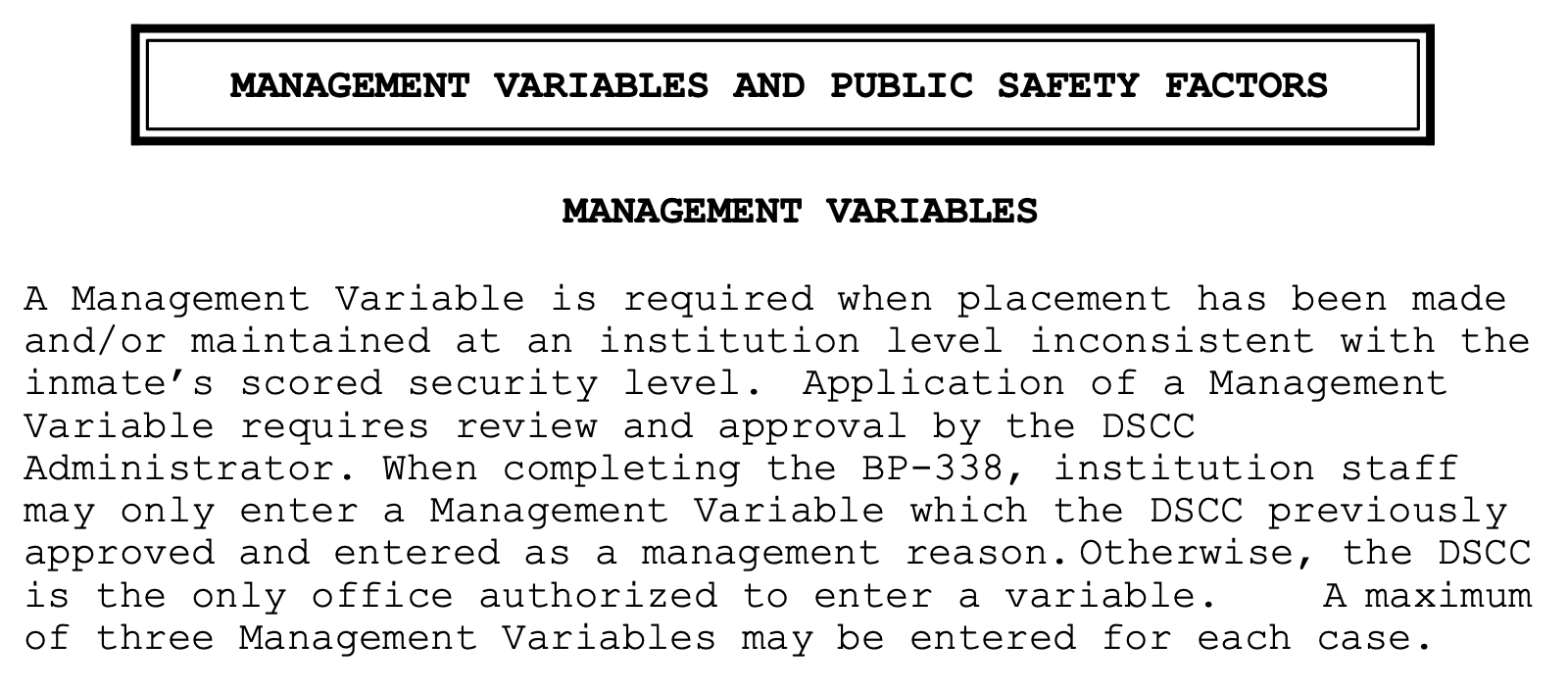
Both PSF waivers and management variables require high-level authorization from a career official known as the DSSC Administrator (the official who runs the BOP’s Designation and Sentence Computation Center). The DSSC is the only staff member in the Bureau of Prisons who has the authority to waive a PSF or to apply a management variable. (Though presumably she could be directed to do so by her bosses, which include the Director of the Bureau of Prisons—more on him in a moment—and the Deputy Attorney General.)
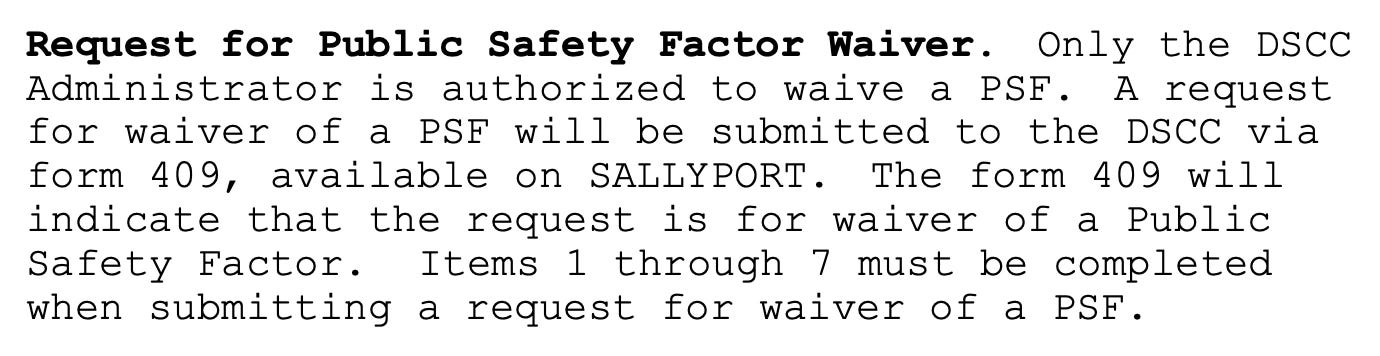
As a matter of practice, PSFs are rarely waived. I have not seen any historical precedent, in my research or my professional experience, for waiving the “sex offender” PSF. As a matter of policy, practice, and common sense, the DSSC Administrator—who is a career corrections specialist—would not have any reason to waive a PSF for a sex offender.
Safety issues and protective custody
So what happens if an incarcerated person is assaulted, threatened, or fears for their safety in prison? Prison staff remove that person from the general population and place them in a restrictive housing unit known as a “SHU” (Special Housing Unit). SHUs are specialized units inside regular prisons that are reserved for individuals who cannot be safely housed with other people for various reasons. Individuals who require protective custody—meaning separation from others for their own safety—are housed in the SHU.
Prisons of all different security levels have SHUs within them. SHUs have extra protections in place, including additional staffing, closer monitoring of residents, and more physical security than the rest of the facility.
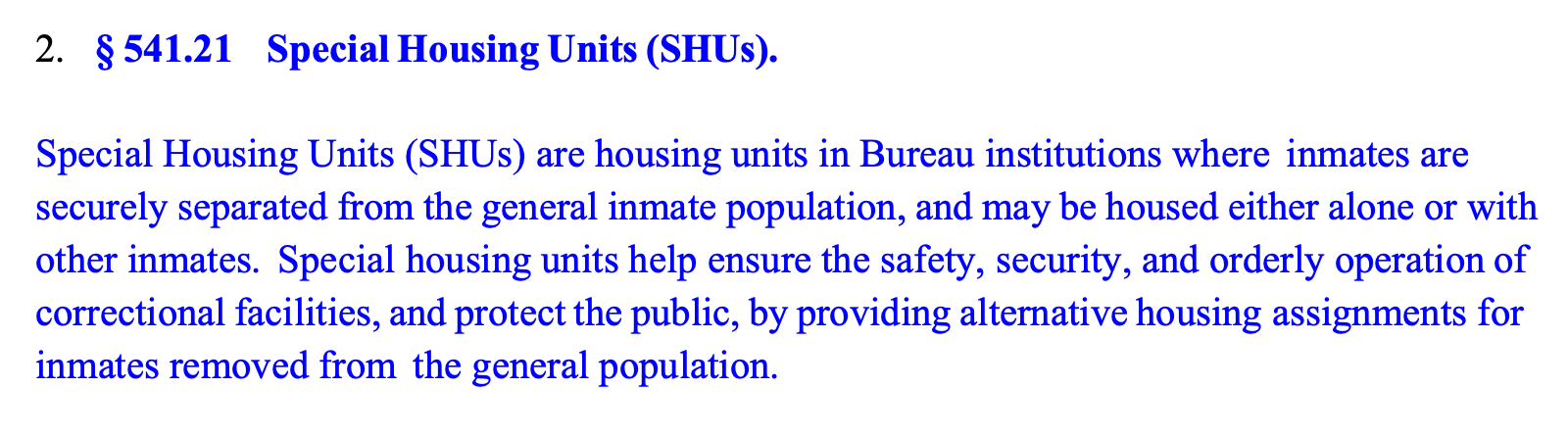
According to BOP’s most recent data, over 10,000 people are currently housed in SHUs (out of a total prison population of approximately 139,000). About 10% of those are in the SHU for disciplinary reasons (i.e., punishment for bad behavior), while the rest are there for administrative reasons, such as protective custody. Placement in protective custody can be voluntary (i.e., at the request of the incarcerated person) or involuntary (i.e., at the direction of prison staff).

No matter what the institution’s security level, living conditions in the SHU are much more restrictive than in the general population. SHU residents are typically housed in cells (as opposed to cubicle- or dormitory-style housing). Their movements are restricted, their outside recreation time is limited, and they are walled off from contact with the general population. Their visiting and phone calls may be limited, and they generally do not have access to Trulincs—BOP’s email system which allows incarcerated people to send emails to an approved list of outside contacts.
Because of the restrictive nature of SHU housing (and the heightened costs of providing such housing), prison staff are required to investigate and verify the need for protection before keeping a person in the SHU. Staff are also required to periodically reevaluate whether protective custody is still needed after the initial placement is made.
A person who has a verified need for protection on an ongoing basis may be transferred to another facility where such protection will not be needed. However, as discussed above, BOP policy requires the individual to remain confined in a facility appropriate for their security level. So an individual housed in a low security prison, for example, could be moved to a different low-security prison—but not to a high or a minimum. Several BOP prisons have Reintegration Units, which are specifically designed for individuals requiring longterm protective custody.
Individuals who have special management needs may also be given a “Central Inmate Monitoring (CIM)” assignment, which requires heightened review and documentation of their movements. Those receiving CIM assignments may include cooperating witnesses or known gang members—as well as persons “who have received widespread publicity as a result of their criminal activity or notoriety as public figures,” among others.
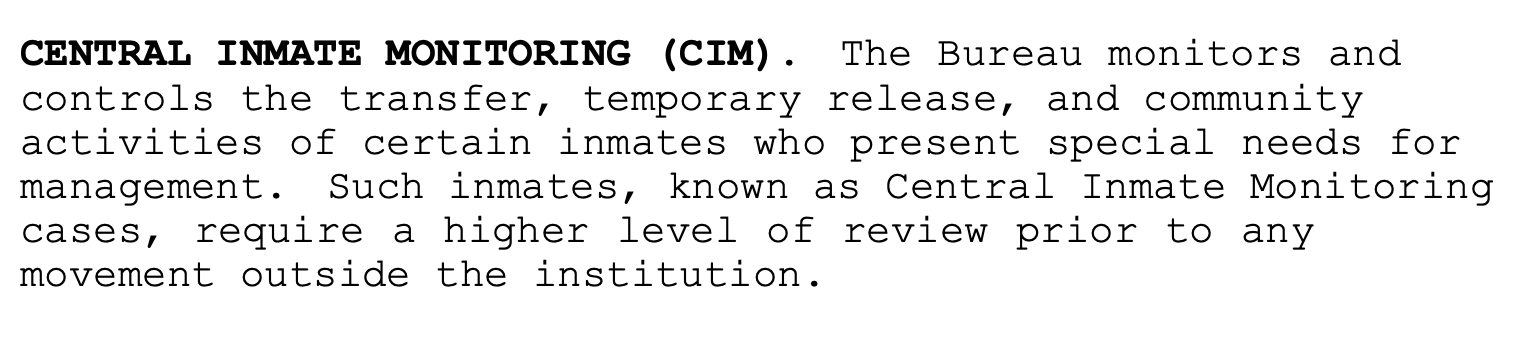
Importantly, decisions about inmate safety are not ad hoc determinations. BOP has detailed policies that staff must follow. A rigorous review process is in place for application of heightened security measures like CIM assignments and special housing placements. Detailed documentation and appropriate approvals are required. Nothing happens without a paper trail.
The lies we’ve been told about Ghislaine Maxwell
Now that you know how things actually work, it’s easy to spot the lies that Blanche’s DOJ has told us. The statement issued by BOP last week is filled with them.
Lie #1: “Inmate safety” is the “most important[]” consideration in designating and transferring people in custody.
The Program Statement discussed above outlines all of the factors BOP considers in the security designation and custody classification process. Inmate safety is actually not one of them. But public safety is. Protecting the public is a paramount concern of the Bureau of Prisons under federal law.
BOP has determined that sex offenders and other detainees with public safety factors (like Maxwell) require increased security “to ensure the safety and protection of the public”—not for their own protection. Because BOP has a legal duty to protect the public, transferring an individual with a public safety factor to a minimum-security institution—“which would permit inmate access to the community”—is not a permissible mechanism for addressing a threat to the safety of a person in custody.
Lie #2: Maxwell was transferred because BOP “could no longer ensure her safety at her original facility.”
It’s not clear that there were any actual threats to Maxwell’s safety inside FCI Tallahassee, where she was originally confined. But even if there were, the facility was quite capable of ensuring her safety by placing her in the SHU. That’s what routinely happens to other incarcerated people who cannot be safely housed in the general population. The primary purpose of the SHU is to provide additional security for those who want or need it.
But it seems that Maxwell didn’t actually want more security. She wanted less security and more privileges. And now she’s got all of that, thanks to Todd Blanche.
Lie #3: The new facility has “improved security measures” to keep Maxwell safe.
FPC Bryan, where Maxwell is now housed, is a minimum security prison camp—the least secure type of federal prison. By definition, it has less—not more—security than FCI Tallahassee. As discussed above, prison camps have less staff to supervise the facility and more freedom of movement within the facility. People can come in and out more easily.
At the prison camps I’ve visited, I’ve been able to park right outside—where incarcerated people are often mingling—and walk right into the building. There are no gates or fencing or checkpoints to keep prisoners in or visitors out.
Even entertaining the fiction that a prison transfer was necessary to provide Maxwell more protection, she would have been sent to a facility with an equal (if not greater) security level. BOP has more than two dozen prisons that house women, including facilities in Connecticut, Alabama, South Carolina, and Minnesota that are classified as low security.
Lie #4: The decision to transfer Maxwell was “made independently by BOP.”
The idea that BOP made the decision to transfer Maxwell “independently” of Todd Blanche is absolutely preposterous, for lack of a more elegant word. As a practical matter, BOP staff would never initiate the transfer of a high-profile sex offender with a public safety factor to a minimum security camp—in violation of longstanding policy—in order to provide her with “additional security.”
But moreover, BOP is not independent of Todd Blanche. The Director of the Bureau of Prisons reports directly to the Deputy Attorney General—i.e., Todd Blanche. Here’s Blanche swearing in the current Director last April. And here’s Blanche this April congratulating the Director on “an outstanding first year” and talking about “working hand-in-hand” with him. (It’s also worth noting that Donald Trump fired the previous BOP Director on his first day in office and handpicked a replacement.)
Blanche has actually acknowledged this before, saying: “every decision that they [BOP] make lands on my desk to the extent it needs to.”
Lie #5: “No preference, special treatment, or political influence played any role in these decisions.”
Maxwell’s prison transfer is the very definition of special treatment. Ordinary people facing safety issues are sent to the SHU. As a public defender, I had clients who spent months at a time in the SHU because they were the victims of serious threats or assaults in prison. Maxwell was sent to a camp. She’s the only sex offender known to be residing in a camp—out of approximately 20,000 sex offenders currently in BOP custody.
Restrictive housing is awful, and I want to be clear about that. The limited movement and diminished communication with the outside world is punitive—even when it’s not intended to be. I believe that all incarcerated people should have humane living conditions. But I do not believe that special treatment should be afforded to the wealthy or well connected. And in fact federal law prohibits it.
A smoking gun?
In doing my research for this post, I came across what sure looks like a clear admission that rules were broken. About six weeks ago, on May 6, 2026, BOP Director William Marshall signed what’s called a Change Notice, amending Program Statement 5100.08—the longstanding policy on Inmate Security Designation and Custody Classification. The change notice (“CN-3”) is only the third amendment to this policy since it was adopted in 2006. And what it says is pretty incredible.
It empowers the Attorney General “to designate or redesignate the place of a prisoner’s imprisonment” at his discretion. In other words, the AG can simply direct BOP staff to place a specific prisoner in a specific facility—without regard for any of the established rules. That means that Blanche now has the authority to send Maxwell to any prison in the country (if this holds up against legal challenges). He could potentially even transfer her to home confinement or a halfway house in the community. And the same goes for any other person in the custody of the Bureau of Prisons. Blanche could force an enemy of the president to serve a sentence for a low-level crime in a maximum security prison. Or he could allow a friend of the president convicted of rape or murder to mingle with the community at a camp. The only apparent purpose of this amendment is to give Blanche carte blanche (pardon the pun) to dole out special treatment in the federal prison system.
The Change Notice adds, oddly, that BOP “may also facilitate communication or correspondence between the inmate and the Office of the Attorney General.” The idea that a federal inmate would need to communicate directly with the Office of the Attorney General is what my teen would call “sus.” Highly sus.
What the Senate can do about this
The Senate will have the opportunity to dig into all of this at Blanche’s confirmation hearing, which is scheduled to take place on July 15 and 16. Before that hearing, members of the Senate Judiciary Committee need to arm themselves with all of the facts. Chairman Grassley and Ranking Member Durbin should determine whether the following (required) documents were completed by the Bureau of Prisons and obtain all available records, including:
Basic inmate information forms: Inmate Profile (PP-44), Inmate Activity Record (BP-381)
Designation and classification forms: Inmate Load and Security Designation (BP-337), Custody Classification (BP-338)
Transfer forms: Request for Transfer/Application of Management Variable/PSF Waiver (EMS-409), Transfer Order (BP-399), Transfer Notice (BP-284), In-Transit Data Form (BP-175), Transfer Receipt (BP-821)
Administrative detention and protective custody documents (if any): Administrative Detention Order (BP-308), Special Housing Unit Record (BP-292), Special Housing Unit Review (BP-295), any threat assessments
CIM documents (if any): Case Information Summary (BP-339), CMC Clearance and Separatee Data (PP10)
Additional information: TRULINCS Contact Request Form (BP-1054); approved visitor and telephone lists; programming records (PEED); disciplinary infractions (PD-15)
Obtaining these documents in advance will ensure that the Committee is prepared to question Blanche effectively about this matter, to seek the truth, and to debunk the lies. Senators should also demand an explanation for the recent Change Notice, which now authorizes Blanche to unilaterally direct the placement and transfer of federal prisoners.
Senators of both parties should want to know the truth about what has happened here before voting on Blanche’s nomination. What it looks like is Todd Blanche cut a corrupt deal with Ghislaine Maxwell to protect Donald Trump. It looks like Blanche abused his position as Deputy Attorney General to give preferential treatment to a convicted child sex trafficker. It looks like he plans to keep doing that. And it looks like he is furiously weaving a web of lies to cover it up.
I’ll be watching this closely, and I’ll keep you informed. Make sure you’re subscribed to receive all my updates.
Excellent public service once again Liz. You're a national treasure!
Todd Blanche is protecting Ghislaine Maxwell bc she has so much dirt in Trump & Friends.