


This is going to sound incredible—or maybe incredibly foolish. But for a short stretch last year, at the start of Donald Trump’s second presidency, there was a belief among career Justice Department lawyers that Todd Blanche was going to save us.
It’s hard to even describe how bad things got—and how quickly—inside the Justice Department after Trump’s inauguration. With Blanche and Pam Bondi both awaiting Senate confirmation, management of the Justice Department initially fell to Emil Bove. Bove is a grim man who was known within DOJ from an earlier stint as a federal prosecutor in Manhattan. There, he had earned a reputation as an aggressive and temperamental manager who left amid a cloud of misconduct complaints. Bove later served alongside Blanche on Trump’s criminal defense team, which led to this early post at DOJ—and then a federal judgeship.
Typically, interim leaders cool their heels until the President’s political nominees are confirmed. But that was not the case with Bove. With astonishing speed, he assumed the role of relentless enforcer of the President’s policies. On Inauguration Day, Bove began purging career lawyers and FBI agents—including some of the Department’s most senior experts. After a shocking wave of early firings and demotions, a friend called to congratulate me on “surviving the first blood-letting.”
Bove did not limit himself to the internal affairs of the Department. He doggedly executed Trump’s immigration agenda. He threatened to prosecute local officials who refused to cooperate. He reportedly directed Department lawyers to ignore court orders limiting their authority and tell the courts, “f— you.” He caused a standoff with career prosecutors over the dismissal of the corruption case against New York City Mayor Eric Adams, a Trump ally, triggering a slew of resignations.
On February 4, two weeks into Bove’s reign, Pam Bondi was confirmed. Unlike Bove, Bondi had never worked in the Justice Department. She assumed a largely ceremonial role as Attorney General. On her first day in office, Bondi sent a slew of stern memos to the career workforce underscoring the importance of loyalty to the President and vigorous pursuit of his political agenda above all else. We were told that those who resisted would be rooted out and terminated. Beyond her written missives, Bondi did not interact with the career workforce. She seemed disinclined to interfere with Bove’s ironfisted management of the Department’s day-to-day work.
Meanwhile, DOGE was operating in the background, gutting some federal agencies and threatening mass layoffs at others. There was a shared understanding among DOJ’s staff that neither Bondi nor Bove would protect us from Elon Musk’s chainsaw. Everyone on my team, and everyone around me, was panicked, demoralized, and afraid.
Someone said to me, early on, that everything would be fine “once Todd gets here.” Ironically, that person was ousted by Bove before Blanche ever arrived. But still, I heard variations of that refrain repeated many times, by many people, up until the day Blanche was sworn in as Deputy Attorney General.
I didn’t know Blanche, so I had no real basis for an opinion. But many of my colleagues knew him from his eight-year tenure as an Assistant U.S. Attorney in Manhattan—one of DOJ’s most prestigious postings. By reputation, Blanche was a capable prosecutor and well-liked by his DOJ colleagues. He also had other respectable legal credentials, including partnership at a top-tier law firm. These ties to mainstream legal circles—the optimistic logic went—had to be deeper and more enduring than a two-year stint in Trumpworld.
The idea that Blanche would be a lifeline or a savior for the Department became a hopeful refrain among career DOJ staff at a very grim time. No one wanted to believe that the early turmoil was actually a feature, not a bug, of Trump’s Justice Department. Nor did we consider that Blanche’s roots in the Department might have been severed clean by his later professional endeavors.
Blanche was sworn in as Deputy Attorney General on March 5, 2025. Two days later, he fired me.
Blanche’s tenure at the Justice Department has been nothing short of devastating—for the workforce, the institution, and the rule of law. The fundamental problem is that Blanche is operating as though he is still the President’s personal attorney. The Attorney General and the Deputy Attorney General serve the United States, not the President personally. But Blanche never made that adjustment. His unyielding loyalty to Donald Trump has compromised his loyalty to the United States.
In legal terms, Blanche has a conflict of interest. The interests of Blanche’s former client, Donald Trump, are frequently in conflict with the interests of Blanche’s current client, the United States. When he assumed the role of Deputy Attorney General, Blanche swore an oath to support and defend the Constitution of the United States. Trump’s demands are often contrary to the Constitution, which has created an untenable situation for Blanche.
Avoiding conflicts of interest is a basic obligation of all lawyers, because it is not possible to faithfully represent two clients whose interests are at odds. But Blanche has refused to take any steps to mitigate his conflict, knowing that doing so could cost him his job. Trump never forgave his first-term Attorney General Jeff Sessions for recusing himself from the Russia investigation to avoid a conflict of interest.
For Blanche, recusal from matters involving Trump is out of the question not just because it would anger the President. The issue is existential. Recusal would spell the end of his usefulness. Blanche’s unshakeable loyalty to Trump is the whole reason he was chosen to lead the Justice Department. He was not selected for his skills or intellect, which are middling. It was his willingness to put his thumb on the scales of justice that Donald Trump banked on.
In this respect, Blanche has not disappointed. As Deputy Attorney General, and now Acting Attorney General, Blanche has repeatedly used his official position to serve the personal and political interests of Donald Trump. He has approved the use of levers of justice as tools of retribution and political warfare. He has signed off on special treatment for the President’s allies and supporters. And when Trump’s interests have conflicted with the country’s interests, Blanche has placed Trump above America, every single time.
Blanche was asked during his Senate confirmation how he would manage conflicts of interest stemming from his prior representation of Donald Trump. He responded: “In the event of any potential conflict of interest, I will consult with the appropriate Department of Justice ethics officials and act consistent with governing regulations.” Once Blanche was confirmed, the Department’s senior ethics official advised him that he needed to recuse himself from matters involving President Trump. That official was fired by Pam Bondi shortly thereafter.
Blanche’s bad acts as Deputy and Acting Attorney General run the gamut from lying to cheating to stealing. It’s hard to compile an exhaustive list, because there have been so many—and there are likely many more that we don’t even know about. Here are some that certainly deserve consideration as the worst of the worst of Blanche’s transgressions.
The Sham Settlement of Trump’s IRS Lawsuit
My pick for the single most corrupt of Blanche’s actions is the settlement of Donald Trump’s $10 billion lawsuit against the IRS. This sham settlement, approved by Todd Blanche, created the $1.776 billion “Anti-Weaponization Fund” and tacked on a staggeringly broad release of claims against Donald Trump and his affiliates. The fund takes nearly $2 billion of taxpayer money and redistributes it through a secret process to allies and supporters of the President, who have no legal entitlement to the funds. Among those who can expect a payday are a cadre of election deniers and January 6 rioters—including those who beat and injured police officers. In a television interview, Blanche scoffed at the idea this might be objectionable, asserting: “People that hurt police get money all the time.”
While emphasizing that Trump would take no money from the fund, Blanche gave Trump an even more valuable payday in the form of a general release of claims by the United States. The release is staggering in scope. It covers all claims, known and unknown, that the United States could assert against Donald Trump, his businesses, and his family members. It prohibits the United States from investigating, auditing, or suing Trump—even after he leaves office—for any actions up to the date of the settlement agreement. In effect, it signs away our rights to seek any recourse from Donald Trump for the corruption, abuse, and looting of our government perpetrated by him and his sons and their companies. We can’t try to recover the ill-gotten gains from the corrupt business endeavors, self-dealing government contracts, and insider stock trading that have lined the pockets of the Trump family. We can’t collect unpaid tax obligations, which could be worth hundreds of millions of dollars. And we get nothing in return.
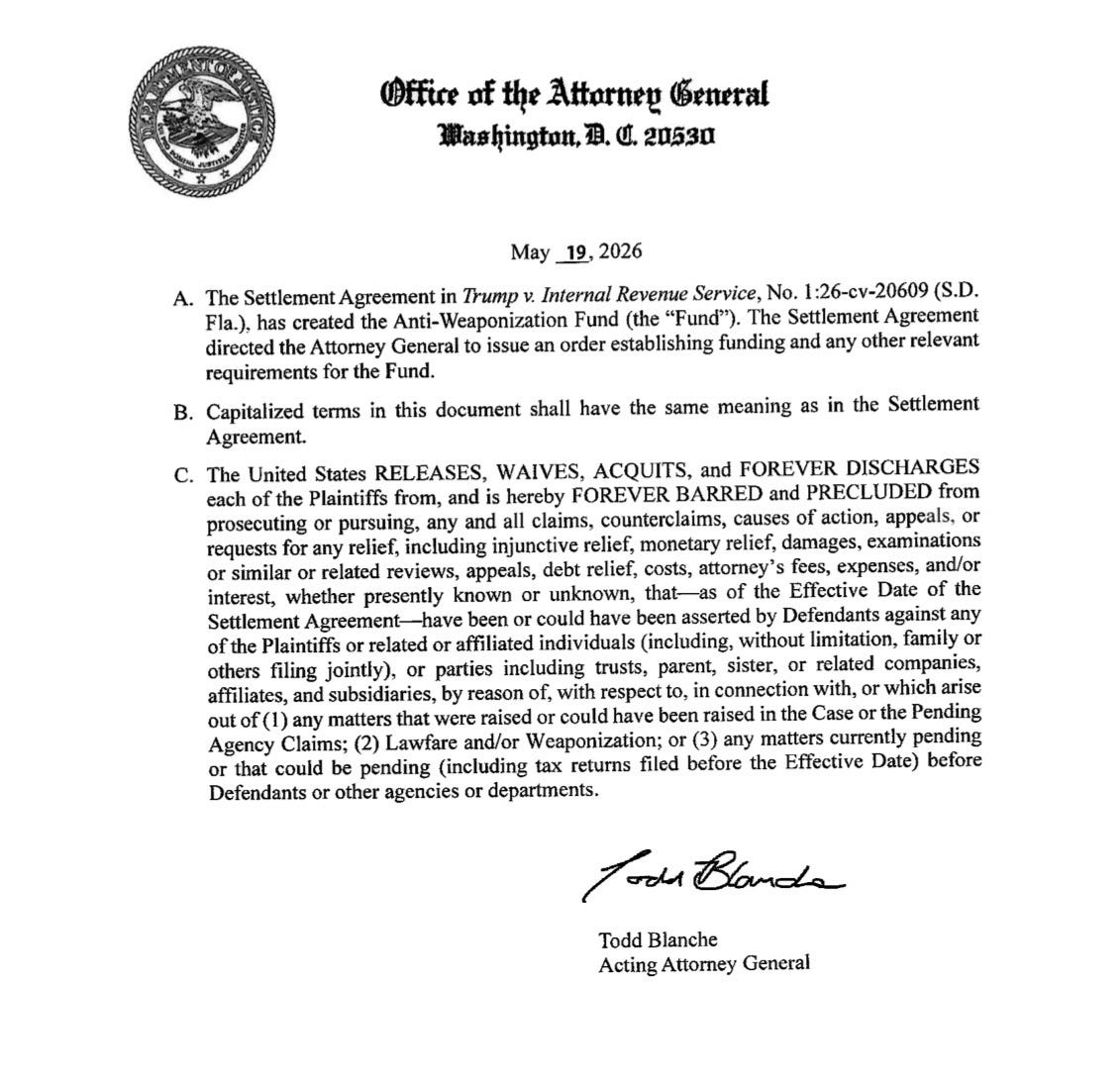
All of this was orchestrated under the pretext of a “settlement” of Donald Trump’s $10 billion lawsuit against the IRS—which only makes it more corrupt. Trump’s lawsuit was utterly frivolous. The presiding judge made known that she smelled collusion between Trump and his Justice Department, and the parties were well aware that dismissal was imminent when they inked the settlement agreement. As a steward of taxpayer funds and the top attorney for the United States, Blanche had a duty to the American people to defend us against this frivolous lawsuit. But instead, he did exactly the opposite. He signed away our rights and our money for the benefit of his former client Donald Trump.
The Epstein Files Fiasco
Before she was ousted, Pam Bondi tasked Blanche with overseeing the Department’s release of the Epstein files. He has botched this responsibility at every stage—most egregiously by failing to protect the personal identifying information of dozen’s of Epstein’s victims. The Department still has not released all of the files as required by law. Blanche has made repeated misrepresentations in defense of his handling of the matter, including falsely claiming that the Department has released all the files when in fact it has released only about half.
Blanche’s legal failures have been accompanied by equally or more disturbing moral failures. In one of his first public statements as Acting Attorney General, Blanche declared his intent to close this chapter without completing it, saying that the Epstein files “should not be a part of anything going forward at the DOJ.” He has persistently refused to meet with Epstein’s victims—and lied about it, falsely claiming in recent congressional testimony that he has met with many Epstein survivors. His dismissive approach to the whole matter is encapsulated in a comment he made to Fox News in February: “the American people need to understand that it isn’t a crime to party with Mr. Epstein.”
The Quid Pro Quo with Ghislaine Maxwell
While Blanche has shown no compassion for Epstein’s victims, he has shown quite a bit for Epstein’s literal partner in crime, Ghislaine Maxwell. Last summer, Blanche personally traveled to Florida, where Maxwell was in prison, and spent two days there meeting behind closed doors with Maxwell and her attorney. (Notably, Maxwell retained David Markus, a longtime associate of Blanche’s, to represent her shortly before this meeting. Markus later spoke about bringing Camembert cheese and fresh bread to this meeting at Maxwell’s request.)
For the Deputy Attorney General to personally interview an incarcerated witness is highly irregular. I don’t know anyone who has worked at DOJ who has ever heard of this happening. For the Deputy Attorney General to personally interview this witness was a travesty of justice and an irreconcilable conflict of interest. The apparent purpose of the meeting was to get a statement from Maxwell exonerating Blanche’s former client Donald Trump from any involvement with Epstein’s crimes. As a convicted sex-trafficker of children serving a 20-year prison sentence, Maxwell of course had no credibility and every reason to tell Blanche exactly what he wanted to hear in the hope that he would return the favor.
And he did. Maxwell told Blanche that Trump was a perfect gentleman. And then she was transferred to a minimum-security prison camp in Texas. This move would not have been possible without Blanche’s intervention. Longstanding DOJ policy explicitly prohibits housing convicted sex offenders in minimum-security camps based on concerns for public safety. Only a top official like Blanche could waive this rule—and there are no known examples of it happening, until now.
The Vindictive Prosecution of Kilmar Abrego Garcia
Blanche’s egregious misdeeds in service of the President’s immigration enforcement agenda are numerous. One that stands out among many is the retaliatory prosecution of Kilmar Abrego Garcia, which Blanche orchestrated. Abrego is the Maryland resident who was mistakenly deported to El Salvador early last year. After a federal judge ordered the Justice Department to facilitate his return to the United States, Blanche opened a criminal investigation into Abrego that resulted in his indictment on charges of human trafficking.
Abrego’s attorneys moved to dismiss the case on grounds of vindictive prosecution, arguing that the retaliatory indictment violated his constitutional due process rights. After conducting an evidentiary hearing, the presiding judge took the extraordinary step of dismissing the charges, blaming “Blanche’s tainted investigation.” The court called the case “an abuse of prosecuting power,” writing: “The objective evidence shows that absent Abrego’s successful lawsuit challenging his removal to El Salvador, the Government would not have brought this prosecution.”
The ruling is remarkable because vindictive prosecution challenges are almost never successful. The law establishes an exacting standard of proof for these claims, which gives every benefit of the doubt to prosecutors. It is even more remarkable that the ruling assigns fault to Todd Blanche personally. Blanche’s personal oversight and involvement in matters of particular political or personal interest to Donald Trump illustrates the extent to which he has abandoned his duties to the country.
Revenge Prosecutions of Trump Enemies
Aware of the President’s frustrations with Pam Bondi’s failure to prosecute his political enemies, Blanche has amped up those efforts as Acting Attorney General. In his first two months in that role, Blanche has initiated a new prosecution against James Comey (the seashell case), indicted the Southern Poverty Law Center, and ramped up the “grand conspiracy” investigation targeting former CIA Director John Brennan and others who purportedly conspired to undermine Trump during his first presidency. Blanche ousted the respected senior prosecutor handling the Brennan matter and replaced her with a Trump loyalist, 81-year-old Joseph DiGenova (posting on his official X account, “Welcome to the fight, Joe!”). Blanche has also reportedly approved new investigations targeting Trump enemies including former White House staffer Cassidy Hutchinson; the Democratic fundraising organization ActBlue; and most recently, 82-year-old E. Jean Carroll, who won civil judgments against Trump for sexual abuse and defamation.
Blanche has wholeheartedly embraced the President’s desire to weaponize the justice system against his enemies. He has claimed the President has a “right” and a “duty” to use the justice system in this way. He has said Americans should be “happy” that the President is dictating the Justice Department’s prosecutions.
All of this is wrong and dangerous. It is the Attorney General’s job to exercise independent legal judgment—not to rubberstamp subversive and illegal actions by the President. It is the Attorney General’s duty to put brakes on executive actions that damage the rule of law and erode public trust in the justice system. Instead, Todd Blanche has enabled these actions. In myriad ways, Blanche has dishonored his oath to uphold the Constitution and violated his professional obligations as a lawyer.
Refusal to Investigate the Use of Force by ICE Agents
At the same time he has shown his readiness to open frivolous investigations into Trump’s enemies, Blanche has refused to open meritorious investigations into allies, supporters, and aides to the President. Nowhere has that been clearer than in cases involving the use of force by ICE agents. Perhaps most shockingly, the Justice Department refused to open a civil rights investigation into the killing of Renee Good, an unarmed citizen, by ICE agents in Minneapolis in January. Blanche declared that there was “no basis” for such an investigation. Federal prosecutors and FBI agents who attempted to investigate were ordered to stand down, prompting mass resignations that left the Minnesota U.S. Attorney’s Office in chaos.
Purges of Career Employees
Blanche has presided over the removal and reassignment of career experts throughout the Justice Department and the FBI. These personnel actions violate longstanding civil service laws that protect career employees from removal without cause and without due process.
I was among the first to be illegally fired by Blanche, last March, after I refused to comply with a directive to rubberstamp the reinstatement of gun ownership rights for the actor Mel Gibson—a friend of the President who had lost his right to own a firearm when he was convicted of a domestic violence crime. After I spoke out about my firing, Blanche accused me of lying, sent U.S. Marshals to my home, and filed an ethics complaint against me with the D.C. Bar, which was later dismissed (but only after I had to hire counsel to represent me).
Blanche also fired other senior experts, including the Director of the Department’s Office of Professional Responsibility (which investigates and punishes misconduct by DOJ employees) and the Director of the Office of Information Policy (which oversees compliance with public transparency laws, such as the Freedom of Information Act). These firings, like mine, were calculated to remove institutional guardrails against corruption and misconduct, which could slow or impede the political objectives of the President.
Blanche has personally or by proxy presided over a slew of other retaliatory firings. During the confirmation process, Blanche offered assurances that career employees who worked on cases involving Donald Trump “should have no fear of losing their jobs,” vowing that “no agent or prosecutor will lose their job if they simply followed assigned duties.” One year later, he announced: “There is not a single man or woman at the Department of Justice who had anything to do with those prosecutions.” In an interview this March, Blanche boasted that he “cleaned house” at DOJ and FBI, removing over 200 attorneys and agents assigned to investigations involving Donald Trump.
Under Blanche’s leadership, the Department’s workforce has been decimated by both voluntary resignations and forced removals. DOJ has lost approximately 25% of its lawyers in the last year, along with thousands of FBI agents. This unprecedented exodus of knowledge and experience has devastating implications for the Department’s ability to fulfill its vital mission of keeping America safe.
Attacks on the Judiciary
Blanche has chafed at any oversight of his actions—even by courts, which are required by the Constitution to judge the legality of executive actions and policies. Blanche has refused to accept limits on executive power, routinely condemning unfavorable rulings as the work of “rogue activist judges.” He has even gone so far as to declare that the Justice Department is at “war” with the judiciary. This attitude and this rhetoric is dangerous to judges, who have faced unprecedented threats to their safety. It is also dangerous to our constitutional order, which is premised on each of the three coequal branches of our government accepting the legitimacy and respecting the authority of the others.
Attacks on State Bars
Blanche has also worked to undermine independent oversight of DOJ attorneys by state bar associations. Every practicing lawyer is required to be licensed by the bar of at least one state (or the District of Columbia) and to follow the rules of professional conduct of that bar. Department of Justice lawyers are no exception. Under federal law, DOJ lawyers are required to abide by the rules of the state bar where they are licensed, and they are subject to the disciplinary authority of that bar. Historically, DOJ lawyers have also been subject to internal discipline through the Department’s Office of Professional Responsibility—but Blanche effectively shuttered that office last year when he fired its director.
State bars—which have the power to suspend or even revoke an attorney’s law license for professional misconduct—are one of few remaining sources of accountability for Blanche and his colleagues. For this reason, Blanche has campaigned to shut them down. Earlier this year, the Department announced a proposed rulemaking—sure to be challenged in court—that would attempt to shield Department lawyers from state bar discipline at the Department’s request.
Blanche has been particularly focused on the D.C. Bar—where many DOJ lawyers are licensed due to the Department’s headquarters in Washington. Blanche has decried it as “one of the most activist, obnoxious bars when it comes to going after conservative lawyers.” He has called it “a blatantly Democrat-run political organization” and a “partisan arm of leftist causes.” In May, Blanche filed a lawsuit against the Bar’s chief disciplinary counsel and his office, accusing them of “weaponization of the bar disciplinary process against federal government attorneys.”
In a well-functioning Department of Justice, leadership welcomes and in fact demands oversight of its attorneys. DOJ lawyers are expected to adhere to the highest standards of ethics and professionalism, because this is vital to preserving the legitimacy of the institution. The job of a DOJ lawyer is not to win a case at all costs—it is to do justice. That means adhering to the law and playing by the rules. The fact that Blanche chafes at this idea is a dim reflection on his character, his methods, and his motivations.
Advancing Conspiracy Theories and Lies
Blanche has not hesitated to embrace conspiracy theories and tell outright lies if they further Trump’s objectives or reinforce his perceived grievances. Blanche has stoked Trump’s dangerous and false election-fraud narrative. He recently told Fox News: “There’s a ton of evidence that the election was rigged.” He has accused elected leaders in Minnesota of “terrorism.” He has stoked mistrust in the media, saying at his confirmation hearing: “I don’t believe what the media says as a matter of practice.” He has also made demonstrably false claims about the Epstein files, the $1.8 billion slush fund, the case against the Southern Poverty Law Center, and a host of other matters.
Blanche often delivers these false narratives in a manner not suited to the Attorney General of the United States, to put it mildly. He has signed his name to court filings on behalf of the United States that read like Truth Social rants penned by Donald Trump himself. He has used his official social media account to attack the press, judges, and his critics—at times deploying the vocabulary of a petulant child (clown emojis; “FAFO”). This pattern of irresponsible, dishonest, and embarrassing behavior by Todd Blanche has made a mockery of his office.
So what happened to Todd Blanche? That question is often asked within the legal circles to which Blanche once belonged. Those who knew him “before Trump”—from his days as a prosecutor or in BigLaw—are baffled by his transformation. I don’t know Blanche personally and I don’t have any special insight. But as a close observer, my perception is that Blanche has genuinely internalized Donald Trump’s grievances and made them his own.
Like Trump, Blanche followed an unconventional path to power. Blanche got his start in the Justice Department working as a paralegal, while he attended law school at night. After graduating, he worked for eight years as an Assistant U.S. Attorney before leaving the Department for private practice. Unlike many of his predecessors, he did not ascend through the intermediate political ranks of the Department. He didn’t hold any of the roles in the Department’s leadership offices that are common stepping stones to the top jobs.
The lack of traditional qualifications could, in theory, be fine and even healthy for the Department, which has long suffered from being too insular. The tradition of leadership ascending through the ranks has at times limited the Department’s ability to innovate, adapt, and even empathize with certain sections of the population it serves. I have long believed that the organization could benefit from leaders with different perspectives and more diverse personal and professional experiences.
But what Blanche brought to the table was an axe to grind. His work appears to be fueled by genuine feelings of moral injury based on his close relationship with Donald Trump. Blanche was Trump’s personal lawyer for two years before he was sworn in as Deputy Attorney General. During that time, Blanche has said he typically worked 70 hours per week on matters for Donald Trump. That’s 10 hours a day, every day. Blanche was in deep.
Even now, Blanche communicates with palpable anger about the past prosecutions of Donald Trump. He lashed out at Jack Smith, calling him “a proven liar,” who made “fake accusations” in “his failed vendetta against the President.” Apparently provoked by a reporter’s question, Blanche added: “The media should stop slopping up the trash dropped by the Democrats on their path to misleading the American public.” He has accused New York’s Attorney General of trying “to destroy the former President’s business and financially ruin him and his children” by suing Trump for civil fraud.
Blanche has derided his critics for their “short memories,” writing on his official X account: “Biden’s DOJ and the Democrat machine tried for years to put President Trump and his associates in jail. They did everything in their power to destroy livelihoods, reputations, and families. They weaponized the government, and that’s something that we cannot and will not forget—they’re corrupt enough to try again.” We will not forget.
It is apparent from Blanche’s public remarks that everything Trump experienced feels very personal to Blanche. Blanche often speaks in the first person about what he endured alongside Trump. Of the supposed weaponization of the Justice Department under Joe Biden, Blanche said recently: “I lived it every single day for two years.” At his confirmation hearing, Blanche said: “I stood next to and defended President Trump as partisan prosecutors and politicians abused our legal system in completely unprecedented ways to fulfill a political agenda—which was prosecuting and attacking President Trump.” Echoing Trump’s grievances about the press, Blanche has said: “I have firsthand knowledge that many members of the media outright lie in the way they ‘report’ facts.”
Blanche’s shared grievances with Donald Trump seem to be amplified by his own rejections and slights. To become Trump’s lawyer, Blanche was forced to resign from his partnership at Cadwalader, a white-shoe New York law firm, and hang his own shingle. The firm’s lack of support reportedly left Blanche bitter. Blanche uprooted his family and relocated to Florida. He bought a home near his client in Palm Beach and switched his party affiliation to Republican. Blanche’s onetime colleagues unsubtly questioned his life choices.
Now in Washington, Blanche has not had the warm reception typically given to the country’s most powerful lawyer. He has faced unsparing criticism from prominent professional organizations. Elite membership groups have shunned him. Blanche, in turn, has banned Department lawyers from participating in events of the American Bar Association—the nation’s leading professional organization for lawyers—which Blanche has accused of undermining the Department’s priorities through its support of “activist” causes.
These dynamics have pushed Blanche further and further into the fringes of the legal profession, at the same time drawing him closer to Donald Trump. The bond he feels with Trump seems to be not just professional but emotional for Blanche. He recently declared, “I love you, sir,” when asked how he would respond if Trump asked him to step aside. He has called his representation of Trump “an honor that I will cherish until the day I die.”
It appeared to some observers that Blanche held onto at least a few scruples during his tenure as Deputy Attorney General. For example, he reportedly opposed the firing of Erik Siebert, the U.S. Attorney in Virginia who found insufficient evidence to support indicting Trump’s enemies James Comey and Letitia James.
But any willingness Blanche may have had to push back on Trump’s demands was abandoned when he was named Acting Attorney General in April. As soon as the President tasked him with delivering the results that Pam Bondi couldn’t, Blanche threw himself all in. As Trump put it, Blanche has been “unleashed.” With eager rivals waiting in the wings, Blanche knows he needs to deliver what the President wants to keep the job.
What sets Blanche apart from other political appointees, including Pam Bondi, is that it appears he wants to settle Trump’s scores as badly as Trump does. Whereas Bondi was known for her performative outrage, Blanche’s outrage comes across as genuine. There is a bitter edge to his words. There is a simmering anger just below the surface.
Blanche is not a true conspiracy theorist in the vein of Ed Martin. But neither is he simply posturing for his boss in the manner of many of his colleagues—like Bondi and Jeanine Pirro—who possess mainstream legal qualifications and strong survival instincts. This makes Blanche a much more dangerous leader.
From my perspective as a lawyer, Todd Blanche is Donald Trump’s most culpable coconspirator. Blanche has made possible Trump’s corruption of our justice system and his looting of our tax dollars. He has been a willing, even eager, participant in the dismantling of the rule of law. All of this has required him to turn his back on his ethical obligations as an attorney and the oath he swore to uphold the Constitution.
What Blanche has done as Deputy and Acting Attorney General is an unfathomable betrayal of the American people. It is an incomprehensible display of disloyalty to the United States—the client he has a sworn duty to represent. Blanche seems to know this. Speaking at a conservative political conference in March, Blanche said everyone in the Trump Administration “is afraid they’re going to get indicted” once they lose control of the levers of power.
Many of us are asking what we can do as citizens to rein in Todd Blanche. One important thing is to keep fighting in court. The judicial process sometimes moves slowly, but it gets results. Late last week, a group of former federal judges successfully persuaded the court presiding over Trump’s IRS lawsuit to reopen the case to consider whether the settlement agreement is an illegal fraud on the court. We won’t know the final outcome of this proceeding for some weeks or months, but in the meantime, a different court has blocked payments from the settlement fund while another legal challenge is considered.
Another thing we can all do is seek accountability through those oversight authorities that are still available and functioning. Calls to our elected representatives (particularly Republicans) are especially important right now, as Congress considers whether to take action to cancel the $1.8 billion settlement pot.
Another avenue of accountability, mentioned above, is state bar associations. Todd Blanche is licensed in New York and subject to discipline under New York’s Rules of Professional Conduct for attorneys. I would argue that Blanche has violated these rules in myriad ways. Anyone can submit a complaint against a member of the bar, for investigation by its Attorney Grievance Committee. I’ll be sharing more information in my next post about how that process works.
Stay tuned, thank you for reading, and please share.
That’s a frightening list that you’ve outlined, Liz. It’s really incredible seeing them laid out in the comprehensive manner you’ve provided. Blanche is dangerous and a threat to longstanding norms and the rule of law in our country. Unfortunately, I suspect nothing will change until the Democrats take over at least one branch of Congress and provide some oversight and accountability. It’s beyond sad that we the people have no legal representation at the top of the Justice Department.
Nothing happened to Todd Blanche. Red the current “ Vanity Fair” article about him. He began as a third rate lawyer of conveniently flexible ethics and he still is.