


As the midterm elections approach, government corruption has emerged as a top issue for voters. Recent polling puts corruption ahead of even inflation and gas prices among voter concerns. The concern is well-founded, as fresh accounts of grift and self-dealing by Trump officials and allies emerge nearly every day. In recent weeks, reporting has uncovered, for example:
Hundreds of millions of dollars in tax-deductible donations to Trump’s ballroom from corporate executives seeking government benefits;
A $50 million employment contract given to a Trump DOJ official by the family of a billionaire pardon seeker;
Accusations that a Trump official misappropriated millions in donations to the Kennedy Center;
Dubious paid consulting work by top Trump advisors for a Russian-allied government;
A lucrative $108 million government contract steered to a donor by the former Secretary of Homeland Security;
A billion-dollar stake held by Middle East peace envoy Jared Kushner in a company that invests in Israeli arms manufacturers;
A lavish wedding party for Donald Trump Jr., bankrolled by a Russian oligarch; and
Allegations that the Ambassador to Greece solicited $100,000 from a Trump donor to pay her American Express bill.
Meanwhile, congressional Democrats are gearing up for “gargantuan” investigations if they retake the House. A slew of subpoenas will likely be served on everyone from cabinet officials to CEOs to lobbyists, pardon recipients, and Trump family members.
As Democrats focus on accountability, those in Trump’s orbit continue to behave as though there is no tomorrow. Why? Not because they believe the elections will go their way. It’s because they are banking on presidential pardons to insulate them from any future consequences.
This is a mistake. Not because the president won’t grant sweeping pardons. All signs suggest that he will. Trump has repeatedly dangled the promise of pardons to those who do his bidding. According to one report, he plans to pardon “everyone who has come within 200 feet of the Oval [Office].” Now, the White House is reportedly considering mass pardons even for junior staffers. Trump has said he doesn’t want to see those who work for him to “go through years of nonsense.”
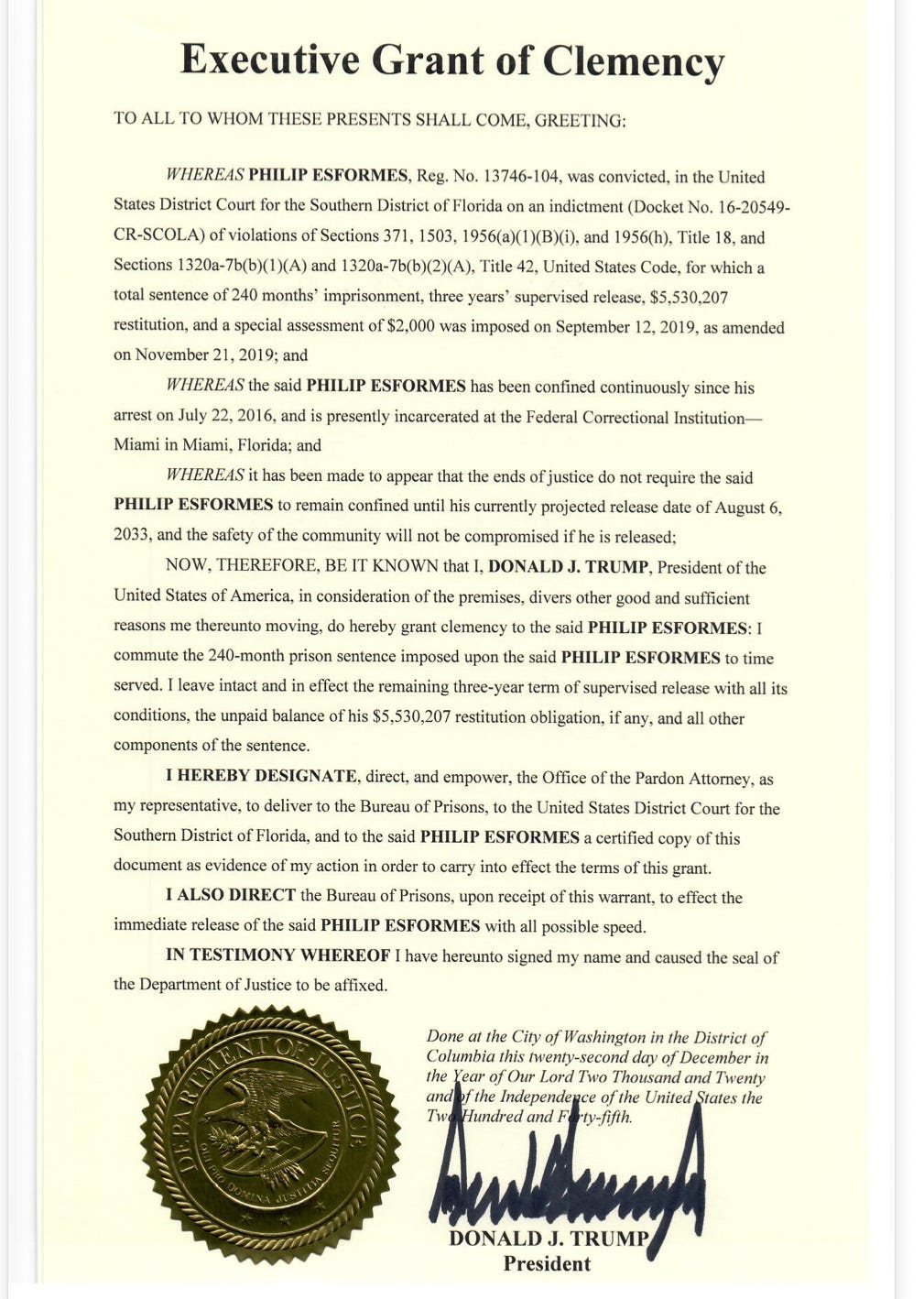
But those who are taking calculated risks on the expectation of being pardoned ought to consider the case of Philip Esformes, a wealthy Miami health care executive who was granted clemency at the end of Donald Trump’s first presidency. At the time, the case was newsworthy because Esformes stood convicted of one of the largest health care frauds in history. A commutation from Trump—which was strenuously opposed by many at the Justice Department—absolved Esformes of the bulk of a 20-year prison sentence.
Esformes was freed from prison, but his legal troubles didn’t end there. Federal prosecutors could not accept the president’s decision to erase the sentence of this man who they believed was “driven by almost unbounded greed” (he used Medicare dollars to finance a Ferrari and a private jet). So, with Trump out of office, they decided to test the limits of the pardon power by reprosecuting Esformes for essentially the same conduct that was the subject of the clemency grant.
A second prosecution was legally permissible, the Justice Department contended, because Trump’s commutation of Esformes’s sentence covered only the charges for which he was convicted at trial (20 counts related to fraud, bribery, kickbacks, money laundering, and obstruction of justice); the official paperwork said nothing about the six additional charges on which the jury failed to reach a verdict. In a move that arguably amounted to exploiting a technicality, prosecutors advised the court of their intent to retry Esformes on the six counts on which the jury had deadlocked and potentially seek an additional prison sentence.
Some on the right criticized the move as the work of “partisan operatives at DOJ” seeking to “erode the legacy of the prior administration.” They argued that it was an “alarming attempt to undercut presidential authority.” One conservative lawyer who now holds a senior position at DOJ described it as “terrible precedent,” asking, “Does this DOJ have no sense of propriety at all?”
Ultimately, the matter was resolved with a plea agreement in early 2024. Esformes pleaded guilty to one count of conspiracy to commit health care fraud. Prosecutors agreed to dismiss the remaining five counts, and Esformes was sentenced to time served—meaning no additional prison time. (Though just months later he was rearrested on domestic violence charges.)
Whether the second prosecution of Esformes was “successful” (or a prudent use of resources) is a matter of perspective. Prosecutors did not succeed in reviving the prison obligation extinguished by the commutation. But they did secure a guilty plea—and notably, the case was not thrown out on legal grounds.
Esformes’s case should serve as a cautionary tale for those banking on future pardons. At the time, the decision to reprosecute Esformes was fairly criticized as a dubious act of prosecutorial pettiness that threatened to nullify the president’s constitutional prerogative to pardon. But now—as the president’s pardon power threatens to nullify the rule of law itself, by emboldening his stalwarts to take increasingly reckless, corrupt, and lawless actions—the Esformes case provides a useful precedent for restoring accountability.
The Esformes situation could be written off as a one-time drafting error in the pardon paperwork, easy to avoid repeating. But I don’t think that would be wise. Exploitable “loopholes” like the one DOJ seized on in Esformes’s case won’t be easy to avoid when the administration wades into the uncharted territory of mass pardons for its enablers.
Trump’s blanket pardon of the January 6 defendants has already proven this point. The pardon, which covers individuals “convicted of offenses related to events that occurred at or near the Capitol on January 6, 2021,” immediately generated a slew of contested litigation over just how far it reaches. Earlier this year, lawyers for Brian Cole, the man charged with placing pipe bombs near the Capitol on the eve of January 6, claimed that the pardon protected Cole from prosecution. Prosecutors disagreed, arguing that the Justice Department’s views about the scope of a pardon are “entitled to deference.” A judge ultimately sided with DOJ.
But this short-term victory could very well come back to haunt Trump officials in the future. In the Cole case and elsewhere, Trump’s DOJ has repeatedly urged courts to defer to “the Executive’s reasonable interpretation of the pardon language.” The next administration will surely insist on the same deference in interpreting the scope of pardons. And their interpretation may not favor those currently in power.
Officials and friends of the administration who are hoping for sweeping preemptive pardons (pardons for crimes not yet charged) should be especially worried. There is little historical precedent for preemptive pardons, and even less for blanket ones encompassing offenses not yet discovered. The handful of preemptive pardons that have been granted in modern history (Ford’s pardon of Nixon; Biden’s end-of-term pardons) have never been challenged in court. The prevailing assumption that such pardons are lawful rests primarily on a passing statement in an 1866 Supreme Court opinion that the president’s power to pardon an offense “may be exercised at any time after its commission, either before legal proceedings are taken, or during their pendency, or after conviction and judgment.” But the Court has never squarely confronted the question whether an individual can be pardoned for undefined and perhaps even unknown offenses.
Moreover, the common characterization of the president’s pardon power as “unlimited” is a misnomer. In fact, the pardon power is in fact restrained by other provisions of the Constitution. If the president grants blanket preemptive pardons to administration officials, there might be a strong argument that he has breached his constitutional duty to “take care that the laws be faithfully executed.” The Take Care Clause is understood to mean, at minimum, that “the President may neither breach federal law nor order his subordinates to do so, for defiance cannot be considered faithful execution.” By effectively removing executive branch officials from the reach of the laws enacted by Congress, sweeping pardons would come awfully close to endorsing total lawlessness.
Today’s pardon hopefuls should be forewarned that there is no binding precedent that would prohibit a future Justice Department from bringing charges based on the good faith belief that the president exceeded his pardon power or failed to exercise it unambiguously. The case of Phillip Esformes is proof of concept. No one knows better than Trump’s enemies that being subjected to a criminal investigation is a punishment unto itself. Even if a pardon ultimately precludes prosecution, it may not spare the recipient the “years of nonsense,” lawyers, and “everything else” that Trump hoped to avoid by pardoning them in the first place.
With the midterms approaching, deterring illegal election interference by administration officials and loyalists is of paramount importance. The only way to do this is by bursting the bubble of executive-branch invincibility. Dispelling the notion that pardons will forgive all sins is the place to start.
Thank you Lawyer Oyer! I'm hoping the next DOJ that pursues justice without fear or favor, it will be you making sure that paid-for pardons will not stand.
Seems as if a pardon which has been bought would be illegal (not faithfully executed). And hypothetically - would ongoing use of funds obtained through illegal means not break some kind of law?